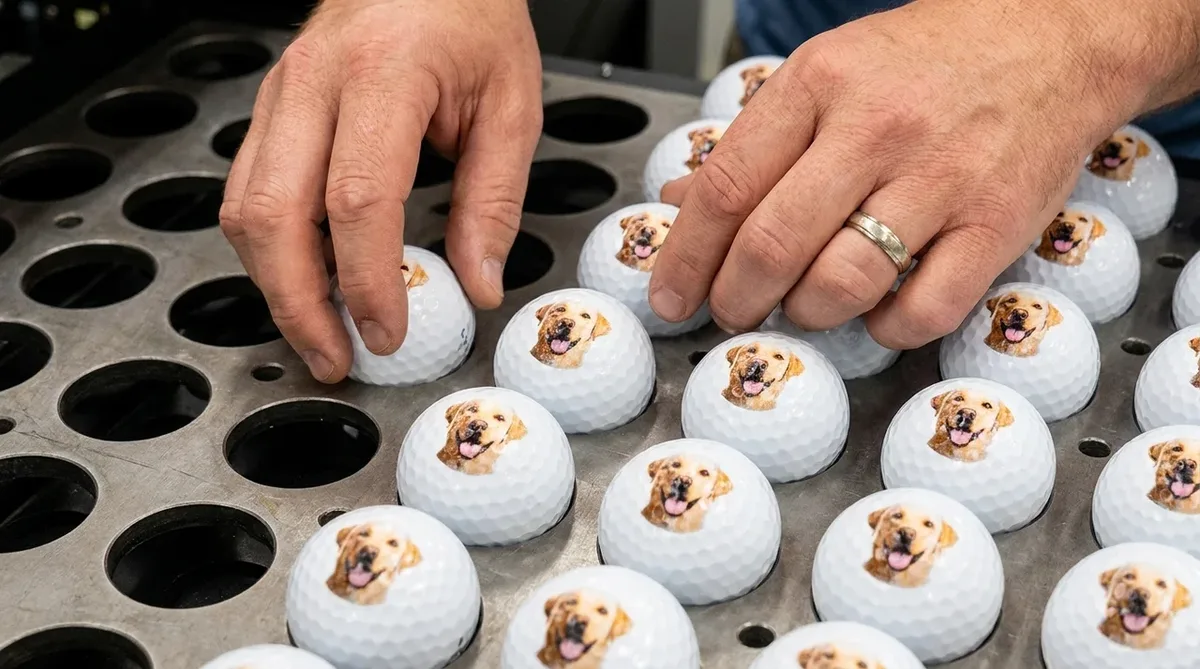
Choosing a print on demand partner starts with the exact product you want to sell, not the size of a supplier's catalog. For personalized golf balls, passport covers, coasters and other hard goods, ask whether the partner can print your specific blank, process each customer's artwork correctly, and ship the finished order in the packaging you agreed on.
A useful shortlist comes down to five things: product fit, an approved sample, a reliable personalization workflow, clear fulfillment terms, and the full cost of a shipped order. Compare those before committing your listings or customer promises to a supplier.
Start with the product, not the printing method
A product name is not a complete specification. Two passport covers may have different coatings, textures or dimensions. A golf ball design may need a small logo, a photograph or a different name on every piece. Those differences affect what you should ask a printer to demonstrate.
Send each potential partner the same brief:
- The exact product or a clear reference photo, including dimensions when available.
- Your intended print area and example artwork.
- Whether every order uses the same design or customer-specific personalization.
- Your expected monthly orders and typical quantity per order.
- Where orders need to ship and any packaging requirements.
Ask the supplier to confirm the material and print area before creating final artwork. If you are still choosing a process, our comparison of UV printing, sublimation and screen printing explains the main questions to consider.
Compare a broad POD catalog with a specialist
Broad platforms can be a convenient starting point when their existing products and ordering tools fit your store. Printify's product catalog and Printful's custom products cover multiple categories, including products beyond clothing. Check the current listing for the exact item, print method, provider and shipping region you need.
A specialist is worth evaluating when you need closer discussion of the blank, print area, artwork handling or packaging. A narrower catalog is not automatically better. The important question is whether the supplier can demonstrate the exact order you intend to sell.
You can also use more than one fulfillment partner. Before doing so, work out how you will explain separate shipments, delivery estimates and support to a customer who buys products fulfilled in different places.
Approve a physical sample before selling
A mockup helps communicate placement. A sample lets you inspect the real object. Request a sample that represents the artwork your customers will actually submit, rather than relying only on the supplier's easiest example.
Check small text, photo detail, alignment and the appearance of the print on the chosen surface. Inspect the packaging as well. Write down the approved design size and placement so both sides have a shared reference.
Ask what care instructions apply and what testing supports any durability claims. Avoid promising that a print is scratch-proof, dishwasher-safe or permanent unless you have evidence for that specific product and use. A good-looking sample alone cannot establish every long-term performance claim.
Test personalization from order to shipment
Personalization creates more work than sending the same artwork repeatedly. A customer's image or name must stay attached to the right product, address and order reference throughout production.
Before launching, agree on how the partner receives orders and files. Ask which store connections are available, what setup is required, and what happens when an image is missing or a name does not fit. Do not assume that support for a selling platform means every personalization app or workflow is already supported.
Run a small test with distinct designs and order references. Confirm how proof approval, corrections, cancellation cutoffs and tracking are handled. The purpose is to catch an unclear handoff before a paying customer depends on it.
Define white-label packaging and timing
White-label fulfillment needs a concrete packaging specification. Ask whether the shipment includes supplier branding, which packing slip is used, what return address appears, and whether branded inserts or special packaging add cost or setup work.
Separate production time from carrier transit time. Ask when production begins, whether artwork approval affects the clock, and how busy periods are handled. Agree on an estimate for your product and volume instead of applying one delivery promise to every order.
For an event or gift deadline, provide the required arrival date before you accept the quote. Confirm how the supplier will communicate a delay and what options are available if a shipment or print has a problem.
Compare the cost of a complete order
The lowest printing price is not necessarily the lowest fulfillment cost. Compare the same order specification across suppliers, including personalization and the destination you expect to serve.
- Blank product and printing.
- Artwork preparation or setup, if applicable.
- Packing, inserts and handling.
- Shipping and any destination-dependent charges.
- The agreed policy for damage, print errors, address changes and reprints.
Also ask whether a monthly commitment, storage charge or minimum spend applies. Our US print on demand fulfillment cost guide provides a framework for comparing the parts of an order rather than just the unit price.
Where Cuztomi fits
Cuztomi provides UV printing and print on demand fulfillment from Gilroy, California. We focus on custom hard goods, including golf balls, passport covers, coasters and accessories, printed on Mimaki flatbeds. We work with sellers, brands and POD platforms, with no minimum order.
The next step is a product conversation, not a commitment to move your entire store. Tell us what you need printed, share example artwork and your expected volume, and describe the packaging and destinations you have in mind. We can then discuss product fit, workflow and a quote for your requirements.